10-14 August 2026
From Still Life to Print Exploration
Workshop focus
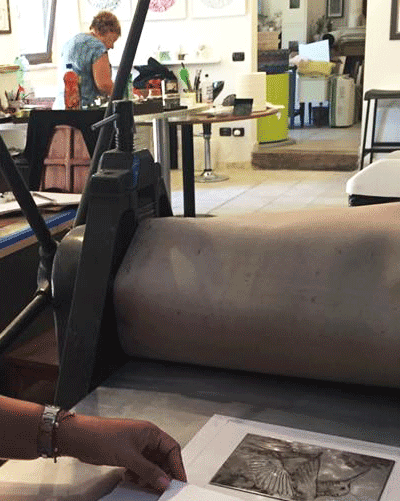
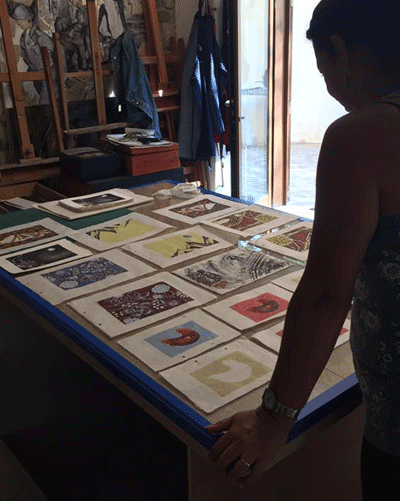
Explore still life as a starting point for printmaking experimentation. Participants will work across monotype, monoprint, linocut, collagraph, and unconventional matrices like Tetra Pak, learning to combine processes, work with or without a press, and develop personal, hybrid prints.
Classes are tutored by
Colleen Corradi , practising artist and printmaker.
All courses are suitable
for beginners as well as experienced printmakers.
Throughout the workshop, the instructor will provide ongoing individual and group feedback, offering constructive critique, guidance, and strategies to help participants refine their compositions, improve technique, and develop their personal approach. Participants will receive support at every stage, from initial sketches to final prints, ensuring that experimentation is purposeful and informed.
Participants are encouraged to explore a range of printmaking techniques and focus on developing a particular area of expertise.
Click here to enrolProgramme
Day 1
Foundation of strong visual structure
PART 1 We will examine what makes a composition compelling, including principles of balance, visual weight, rhythm, and focal points. We will consider examples from both classical and contemporary approaches, highlighting how historical strategies inform modern practice. Through discussion, observation, and quick sketch exercises, participants will develop an intuitive sense of how to arrange elements, guide the viewer’s eye, and create dynamic, engaging compositions for printmaking.
PARt 2: working with Line: Exploring mark-making through monotype drawing. In this session, participants will focus on line as a primary expressive element. Using the direct tracing monotype method, each participant will experiment with the direct tracing method, exploring how marks translate into printed surfaces. Emphasis will be placed on gesture, fluidity, and variation of line, building on the morning’s compositional studies. This hands-on session encourages participants to develop a personal, responsive approach to line and understand how it can guide the composition in printmaking.
Day 2
Day 2 builds on initial sketches and compositional studies by focusing on expressive line, tonal contrast, and experimental monotype techniques. Participants will explore both additive and subtractive methods, creating prints that emphasize strong visual contrast and dynamic mark-making. The session encourages the use of stencils, found objects, and unconventional tools to generate unique textures and patterns, allowing participants to expand and develop their initial compositional ideas. This hands-on practice fosters a personal, experimental approach to printmaking while maintaining clarity and cohesion in the compositions.
Day 3
Collagraph and experimental surfaces: Building texture and depth through collagraph matrices Participants will focus on designing and constructing collagraph plates, using found materials such as cardboard, paper, Tetra Pak, and caulking silicone to add texture, relief, and surface variation. The tactile, three-dimensional matrices will be set aside to dry before printing. This day encourages imaginative material use, observation, and experimentation with unconventional textures that will influence the final prints. While waiting for the collagraphs to dry, participants will explore overprinting, learning techniques for perfect registration as well as how to manage intentional partial overlaps or shifts. They will also experiment with ghost prints pulled on Day 1 or 2, adding new layers of printed material to build complexity and depth.
Day 4 And 5
Linocutting: The session begins with demonstrations on carving, inking, and printing techniques, emphasizing control, texture, and creative mark-making. Participants will also explore reduction linocut, learning how to build multiple layers of color from a single block. This process emphasizes careful planning, sequential printing, and the interaction of colors and shapes, giving participants a deeper understanding of color layering, registration, and tonal harmony within their prints. Participants will then integrate linocut with other processes developed earlier in the workshop, creating hybrid prints that combine the strengths of multiple techniques.